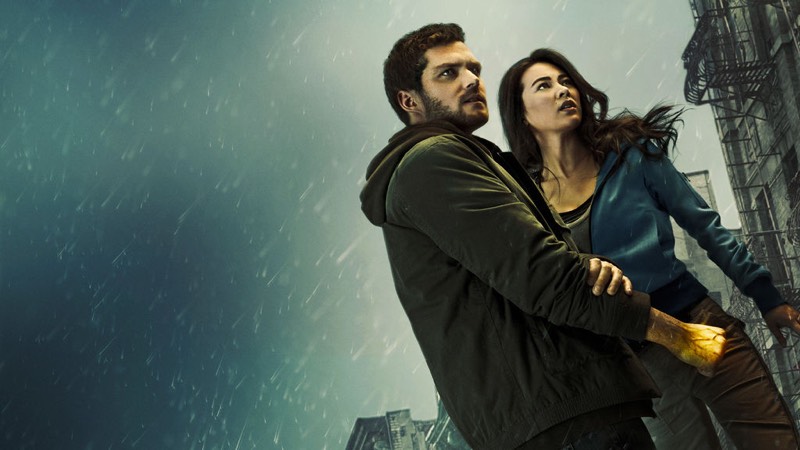
⭐️Iron Fist Season 2: Huh. I didn’t like season 1, or The Defenders. But this new season is really good! (Not just “better than”.) At ten episodes, it’s shorter than other recent Marvel TV seasons on Netflix, which is to its benefit. The first couple of episodes move slowly as they re-establish the relationships, but the second half of the season is very solid. Colleen Wing and Misty Knight make a great on-screen pairing, and I was surprised by how attached I felt to Ward Meacham. He’s still an asshole, but he is trying really hard to rebuild himself after the crisis he suffered in season 1. I had my doubts about how wishy-washy the character Mary seemed in episode 1, but she came back strong. Finn Jones as Danny Rand is not insufferable any more, although I found it hard to deal with Sacha Dhawan’s Manchester accent as Davos. He has good screen presence but his voice doesn’t back it up. I don’t want to spoil anything, but at the end of episode 8 there’s a “damn, they’re really going to go there?” moment, and the last two episodes are terrific. The final moments tease what’s to come in season 3, and if they follow through on that it could be amazing.
Books:
Ms Marvel vol. 9: Teenage Wasteland by G. Willow Wilson, Nico Leon, et al. Fun to see Kamala’s friends step up to the plate to try and keep things running while she is away.
Velvet vol. 2: The Secret Lives of Dead Men by Ed Brubaker, Steve Epting, and Elizabeth Breitweiser. More cold war spy action and intrigue. If this were an ongoing series I’m not sure if I’d keep going, but there’s only one more volume so I’ll see how it resolves.
The Bedlam Stacks by Natasha Pulley. I’m not normally one for steampunk, but I had hoped for something more humorous and action-filled, but it’s meandering and meditative. Not quite my thing.
⭐️ The Broken Earth trilogy by N.K. Jemisin (The Fifth Season, The Obelisk Gate, and The Stone Sky) Very good, but three Hugos in three years implies something quite extraordinary, and I wouldn’t put it one that level. (Take my opinions with a grain of salt right now, though.) It covers lots of themes explicitly, such as environmental destruction and prejudice towards “outsiders”, and many more (race, gender, sexuality) with a kind of subtlety and matter-of-factness that makes you wonder if this was actually written twenty years in the future where such things are taken for granted. It also covers a giant world-ending plot with great pacing and complex characters.
Split Second by Alex Kava. Serial killer/FBI profiler thriller. No more than ¯\_(ツ)_/¯
Films:
💩 What’s Pacific Rim: Uprising? Not much, what’s Pacific Rim: Up with you? (Bad film, bad joke.)
Whisky Tango Foxtrot Good
Red Sparrow Had some good bits, but it could have hit most of the same character and action beats without the scenes of sexual degradation.
⭐️ Ant-Man and The Wasp Enjoyable superhero action.
I’ve been going through a phase of depression. I’m familiar with the signs and symptoms, and how they manifest for me specifically. (I keep a checklist of my idiosyncrasies that don’t get covered on the standard lists. I get disproportionately sensitive to and upset by bad smells, for example.) It has happened before, and it will happen again. Until now I have always managed to deal with it by working with a therapist, focused on cognitive behavioural therapy (CBT).
This year it has been different, and worse. It kinda snuck up on me. (Or rather: it probably always sneaks up on me. This time it just came from an unfamiliar angle.) April was when one piece of realization clicked into place. I read Cate Huston’s blog entry Whose Expectations are Those, Anyway?, in which she talked about Gretchen Rubin’s Four Tendencies framework. It’s an understatement to say that I’m not a fan of reductive personality summaries, and I should withhold judgement until I’ve actually read the book. But the brief description of the “obliger” type fit me distressingly well. I was distressed.
Obligers respond to expectations from other people. They struggle meeting their own expectations.
Expectations is something I have always struggled with, specifically: living up to what I imagine other people’s expectations are for me. It’s a key point I keep coming back to in therapy, year after year. At its worst, it chases me out of jobs: over time I become so terrified that people will expect me to be knowledgeable, that I can’t open my inbox for fear of what my colleagues might ask of me. I get scared of being visible on chat, and of receiving text messages, in case a friend wants to meet up for lunch. My value system associates being a good person with helping other people, and being generous with my time and attention. But I’m not very good at setting limits to how much of myself I give away, or at telling when I’m all used up.
Looking back, I’ve been in a constant state of “used up” for quite a while. There are reasons I got into in that state. The hard emotional work of the last couple of years was necessary, and I don’t begrudge it. But I’m in my mid-40s now, and I don’t have the energy of a 20 year-old. I also didn’t (don’t) have the boundaries and emotional defences in place to deal with saying “no” to requests that are perfectly reasonable for the people asking them, but are more than I feel I can handle. I’m very good at concealing my feelings, and putting on a show of being just fine: Of course I’ll help. I may be stressed, but I’m dealing with it. I’m working hard, but staying cheerful.
Pretending to be me.
2018 was all about stumbling on, feeling ever more burned out. The negative thoughts piled up and up, and made it hard to concentrate on everyday tasks. Interruptions would upset me, and irritations would quickly grow into simmering anger. Keeping a lid on my feelings, and putting on a brave face — both in person, and on chat — kept taking more effort, until it felt like that was all I was doing. Just like when you repeat a word over and over again until it loses meaning, the smiles I faked and the cheer I portrayed became disconnected from actual emotions, and associated with mere pretense.
If I watched a movie, I could say that I enjoyed it, but what did I mean by that? Did I actually feel anything resembling pleasure? No. I was making a robotic assessment of its qualities, and translating that into what Martin would have said. When I visited Edinburgh, I would go to familiar restaurants and cafés. I would order my “favourites”, because that’s what Martin does, and wonder if this blend of sweet and umami is what “tasty” felt like. I went to concerts because Martin already had a ticket and I shouldn’t waste it, not because I wanted to go. (What does “want” feel like, anyway?) And then I stood there seething whenever someone inevitably came and stood in front of me, blocking my line of sight.
And then lying about it. Was I looking forward to this or that? Yes. (What does “looking forward” even mean? I don’t understand.) Do I love you? What does love mean? Am I feeling anything right now? I don’t want to be hurtful, but I don’t want to say something I’m not sure is true. For months, the only emotions I genuinely felt were fear, dread, disgust, and “do not want”, and these are exactly the things I don’t generally talk about. So I didn’t talk. I kept myself flat, and I shut down.
When Scott Hutchison, and Anthony Bourdain committed suicide in May and June, their deaths hit me hard. I don’t have suicidal thoughts. There are so many things out in the world to do and see and hear (even though I might not “want” to do them right now), that I’d be really annoyed if I died before I got to them. But during depressive episodes I do want things to go away, or to end. I go to bed abnormally early, just so I can stop being conscious. And I wonder what it would be like to walk away from this life, leaving everything behind. Even though I don’t act on it, realistically I have that freedom. I wonder if Scott Hutchison and Anthony Bourdain acted the way they did because they felt like they didn’t have that freedom. I’m sad for them.
Abi eventually introduced me to the term “anhedonia”:
Anhedonia is a diverse array of deficits in hedonic function, including reduced motivation or ability to experience pleasure. While earlier definitions of anhedonia emphasized the inability to experience pleasure, anhedonia is used by researchers to refer to reduced motivation, reduced anticipatory pleasure (wanting), reduced consummatory pleasure (liking), and deficits in reinforcement learning. In the DSM-V, anhedonia is a component of depressive disorders, substance related disorders, psychotic disorders, and personality disorders, where it is defined by either a reduced ability to experience pleasure, or a diminished interest in engaging in pleasurable activities. While the ICD-10 does not explicitly mention anhedonia, the depressive symptom analogous to anhedonia as described in the DSM-V is a loss of interest or pleasure.
It’s a symptom, not a condition in itself — there’s no drug or treatment for it, but it is characteristic of depression. Like when I read Cate’s article in April, this was a very “it me” moment.
In June and July I also interviewed for a couple of jobs, and one of them came through with an offer. In 2010 I left my job at Skyscanner partly because I was in a trough of depression. Even though in the long term that worked out okay, I had long told myself that I shouldn’t do that again. Leaving a job is a way to break out of a depressive cycle at work, but that’s also when my sense of self-worth is at its worst. So that’s not a great time to be interviewing. Especially when the anhedonia was making it impossible for me to really say if I genuinely wanted any of the opportunities I was pursuing.
July was a crisis time at work, a crisis time between me and Abi, and a crisis time for myself and my own identity. During one of the interviews I got asked the question: what would you do if you won the lottery and didn’t have to work any more? I found this hard to answer honestly, because the whole concept of wanting something felt utterly alien to me. I used to think that I would go back to university and study some more, but I’m not that person any more. In fact, I’m not even sure what kind of person I am now. I don’t know what I want or like in something as simple as a movie or a meal, let alone in my future career. So the answer I ultimately gave was: I would take some time to deliberately not do things, so that I could re-learn what I enjoy in life, and to rebuild myself from the ground up.
I didn’t get that job, but the question and my answer stuck with me. For the first time in a long while I had discovered something I actually wanted, even needed: some time free of obligations and expectations. Time in which I didn’t have to regularly do anything in particular, with the inevitable anhedonic realization that — no matter what it is — I don’t actively “want” to do it. (Which dovetails with the depressive spiral in which I feel trapped by having to do things I don’t want to do.) Having gone through a similar thing with Fiona last year, I’m very aware of how time plays a part in recovering from mental health problems.
We already had some holiday time scheduled over the summer, and we had consciously chosen not to go anywhere this year. But even holiday time comes with an expectation that it’s limited and precious. I needed to break out of that. I’m fortunate to work for a company that cares a lot about the mental health of its staff. I talked to my manager and tried to explain what was going on in my head. I felt there were three paths open to me: quit and move to the new job I had been offered (taking some time off before starting there), take some unpaid leave from my current job, or the Hard Brexit option of just quitting entirely and figuring things out later. My manager was extremely supportive, and immediately paved the way for me to take some sabbatical leave, right after my holiday. I’ll be staying with FanDuel when I return.
So that’s where I am now. I’m tackling the depression from three angles: therapy, medication (the first time I’ve tried that), and time off work. The term “sabbatical” brings to mind the idea of undertaking projects I wouldn’t have time for otherwise. I suppose that’s true, in the sense that the project I’m working on is me. As I’ve alluded to in recentposts, my strategy is to pay close attention to my own feelings (mindfulness) and to learn to recognize when there is a glimpse of something I enjoy, or want to do. And then pursue that feeling and see where it leads. I started out by calling it “finding my joy”, but Abi coined the phrase “chasing Tinkerbell”, which is much more evocative.
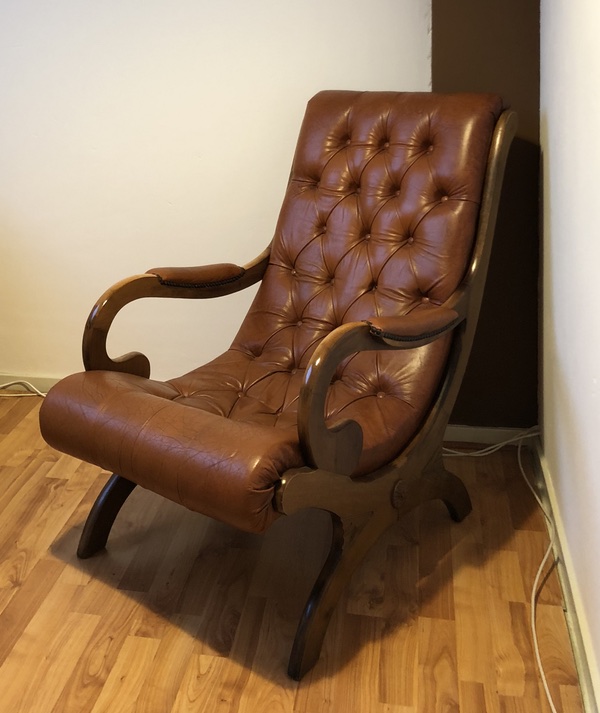
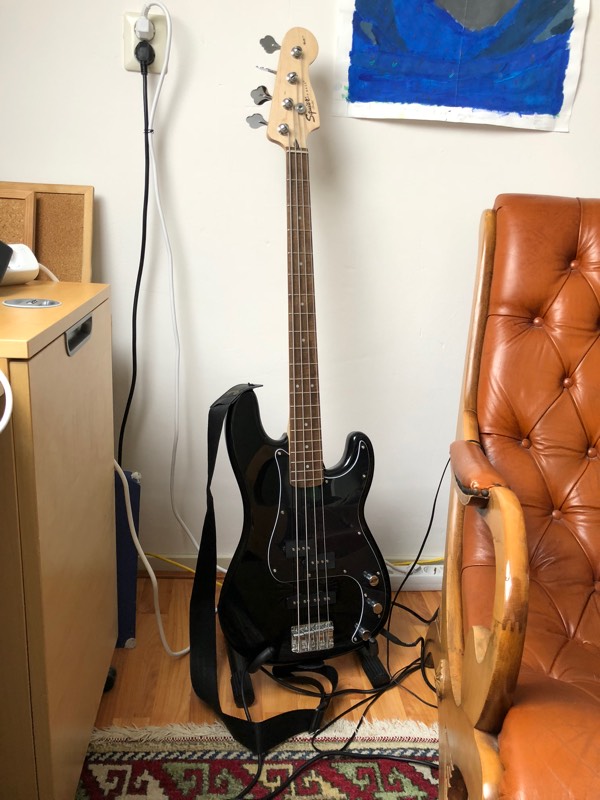
Sometimes it’s taking a walk to watch the crows and magpies defend their roosts. One day, I felt like browsing second-hand furniture shops, and I came home with a lovely comfortable chair I spotted for €35 that feels rewarding every time I sit in it. I’m starting to play the bass guitar. When I wake up in the morning, after going to the toilet I crawl back under a warm duvet for a while and savour the contrast of a cool breeze from the open window. I’m trying to resist the idea that all of this is selfish and self-indulgent, and that I should be working and should be using my time more productively. With the help of my family and friends and therapist I’m succeeding at least some of the time.
My new old chair. €35
I still feel numb to most things. But I’m in a place right now where the potential for negative emotions has been reduced to the point where I can at least detect moments of positive emotion, and try to encourage them. I’ve changed the signal-to-noise ratio in my favour. I’m not “better”. But I think it’s helping.
I used to play the drums. Not very well, and not very much, but I had a Pearl Rhythm Traveller kit in 2001, and a Roland TD-3 electronic kit in 2007, and I enjoyed them. But even playing on an electronic kit sends vibrations through the house, and eventually time constraints and waning interests collided, and I stopped. Rhythm has always been my thing, though, and I always figured that if I picked up a different instrument it would be the bass guitar.
Over the last month or so I’ve been trying “chase Tinkerbell”: to pay attention when my brain sends out a fleeting spark of desire or interest, and follow it where it may lead. When I was in Edinburgh in August, the spark turned out to be musical. While I was redecorating my study, I thought that a drum kit might fit nicely into the one empty corner — but once I moved all the furniture back it, it turned out the corner wasn’t empty after all. Also, the problem of drumming noise hasn’t magically been solved in the last ten years. But a bass guitar, now…
I mentioned it to my manager Keith when I had lunch with him on the Monday. He plays bass, and he had some tips on what to look for if I wanted to get started. On Tuesday I had lunch with Alan Ramsay at Frizzante (which is rapidly turning into my favourite Italian restaurant), and I walked down to Dean Bridge with him afterwards. On my way back towards Pollock Halls, Tinkerbell struck. I knew there was a music shop in the Grassmarket (Red Dog Music), and I stopped in to have a look. A very helpful sales associate talked me through the options, and pointed out the various beginner packs that were available: bass, strap, cables, and a small amp, with prices starting at a modest £250 or so.
“Hmmmmm,” my brain said. By coincidence, my flight to Edinburgh on the Sunday evening had been delayed by 3 hours and 10 minutes: just enough to trigger EU 261 compensation, so long as “extraordinary circumstances” (such as bad weather) didn’t apply. Easyjet make it very easy to make a claim for EU261 compensation, and there is no need to go through a third-party company that will act on your behalf (for a 25% cut, plus taxes). A successful claim would net me €250. So if the claim was successful, I could say that Easyjet bought me a bass guitar…
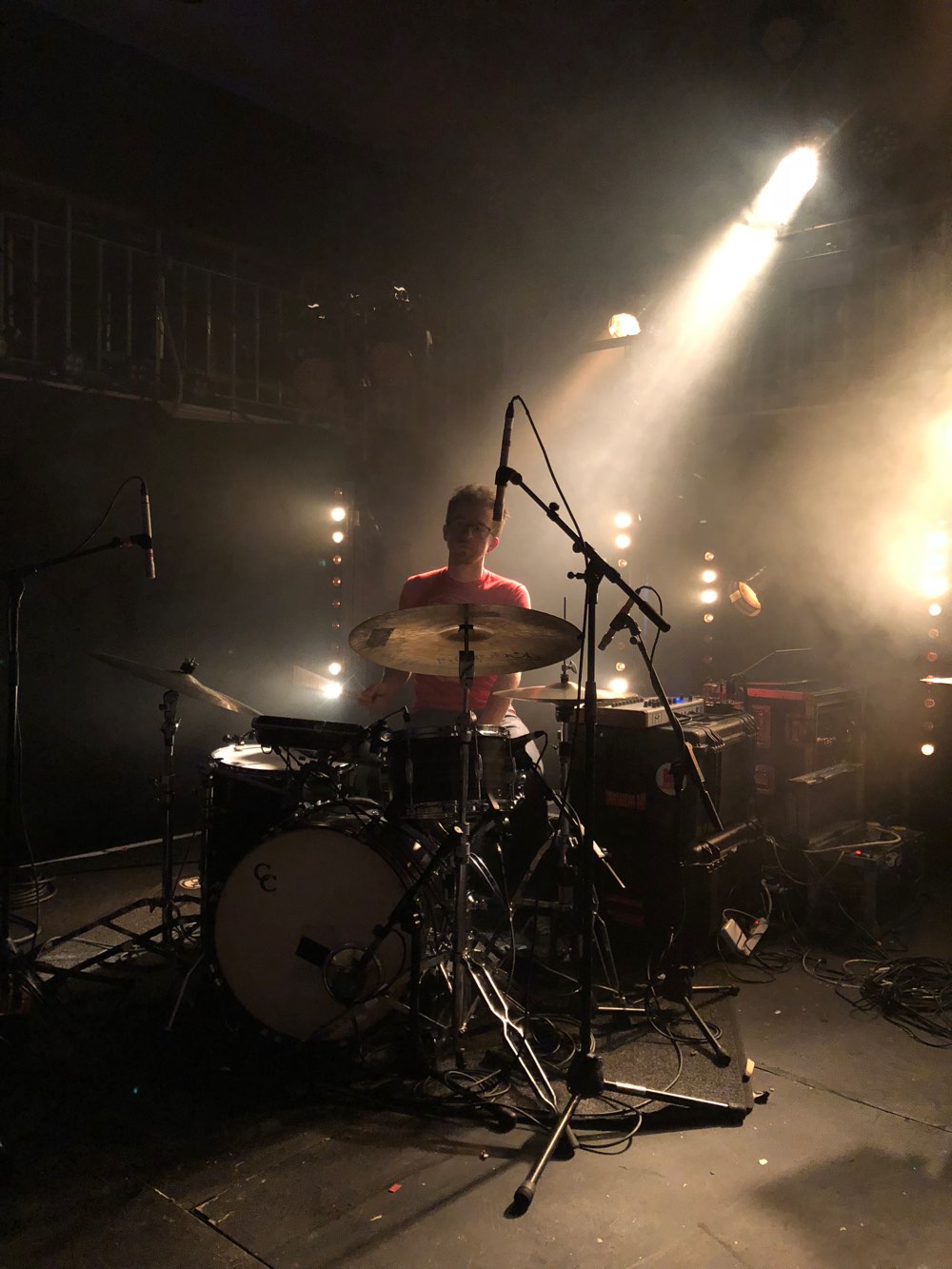
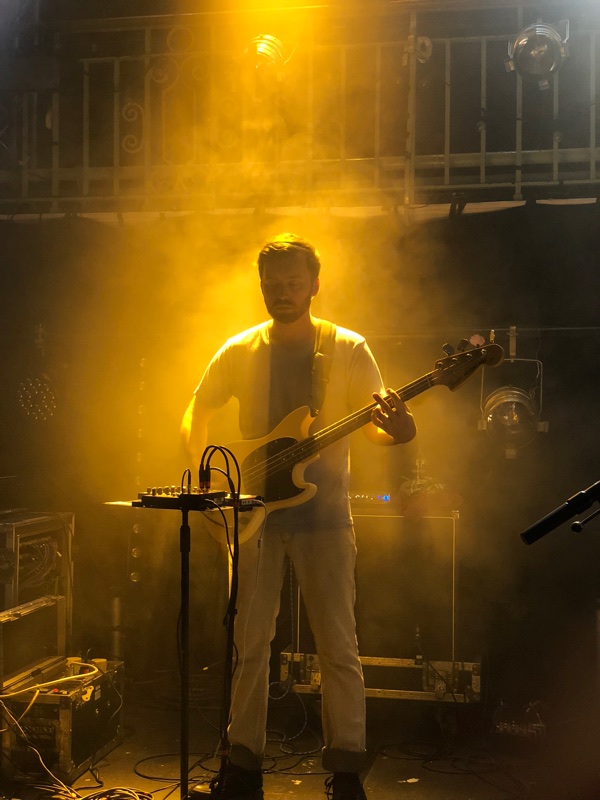
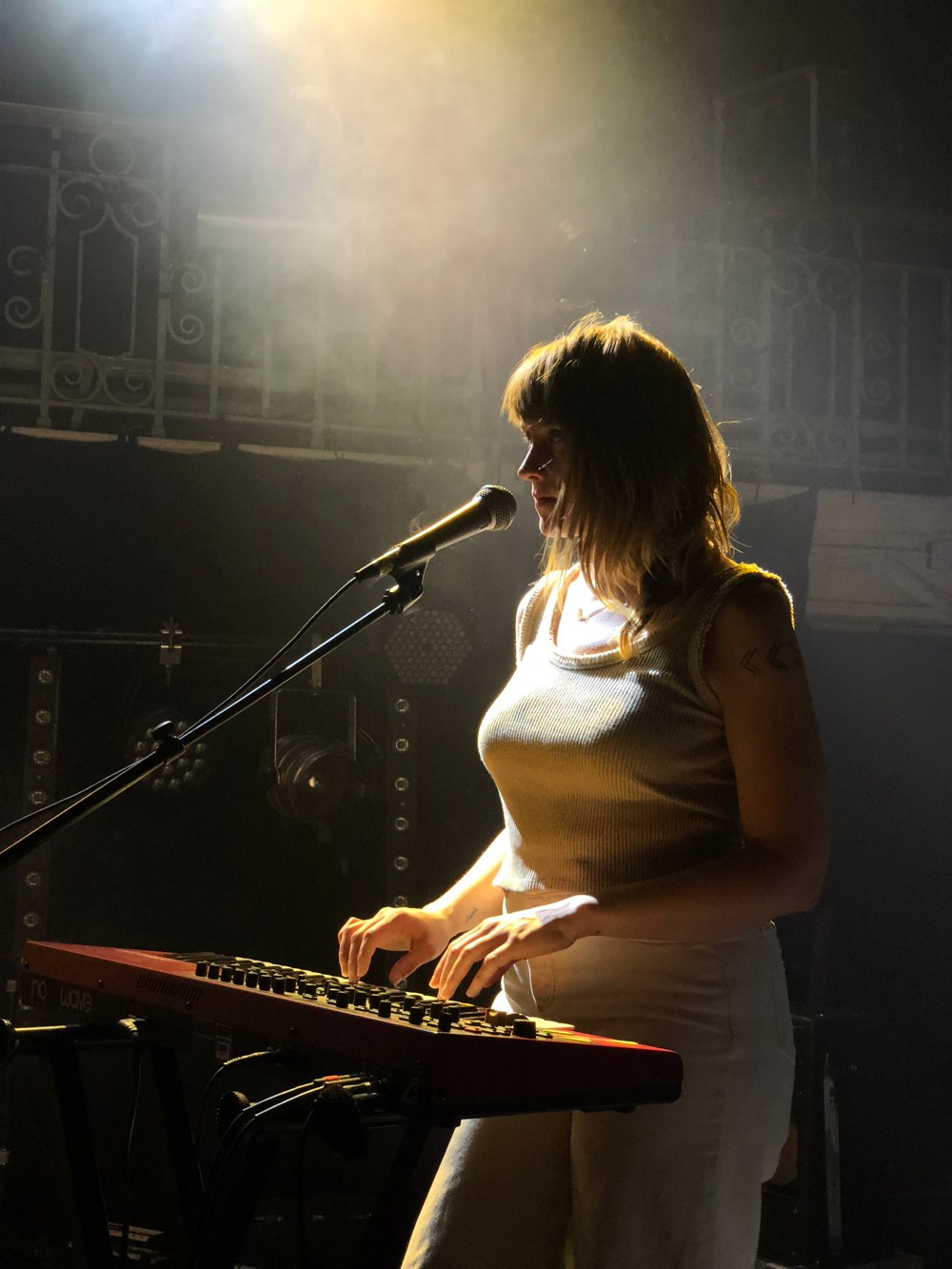
That evening I went out to the Wye Oak gig at Summerhall. (The last concert I’d been to, back in April, had also been to see them, at Tolhuistuin in Amsterdam.) Madeline Kenney played a warm-up set, then the building was evacuated because of a fire alarm, and then Wye Oak came on and played. Last time it had just been Jenn Wasner and Andy Stack, but this time they had a bass player (Will Hackney) with them as well! At most gigs, I spend a lot of time watching the drummer. This time, I found myself following Will’s hand movements on the bass, and imagining myself playing it. It was a good feeling.
Normally Wye Oak don’t play encores, but they made a special exception this time:
Coyote (cover of a Joni Mitchell song)
Jenn Wasner – Wye Oak at Summerhall
So when I got back home I spoke to Abi about it, and she was supportive of the idea. I did some online research and scouted out music shops in the area.
In the end I decided not to take part in the 100 van Leeghwater 100km walk at the start of August. There are various sensible health-conscious face-saving reasons I could give:
We were right in the middle of a heatwave, in an extraordinarily warm summer, and it had been up over 30° during the day. Just as I intended to skip the walk if it was raining, the heat was too intense for that kind of extreme physical activity to be sensible.
Partly because of the heat in the weeks leading up to the walk, but also because of other factors, I hadn’t stuck to my training plan, and so I wasn’t at peak walking fitness.
I am very sensitive to sleep disruptions these days, and a night of little sleep can knock me off my stride for a day or two. Walking all the way through the night was going to knock me out for several days afterwards. Just as I find the sensation of a hangovers not worth the pleasure of drinking the night before any more, I really dislike the dragged-out sensation of not enough sleep.
And while all of these factors played a part, the truth is that I asked myself the question: “do I actually want to do this?” and came up with a “no.” There are plenty of things I have to do, but I’m making an effort to reduce the number of things that I only feel I have to do, and to spend more time doing the things I want to do. Paying the entry fee for the walk, and telling people that I was going to do it were encouragements for me to go through with the walk. They would have worked better if the walk was something I wanted to do in the first place, but my relationship with “want” is strained right now.
Persistence-support mechanisms can be useful, but they can also drag you down if you change your mind, or don’t achieve a goal for some reason. In making the decision not to walk, the hardest part was not feeling like I was failing at something. Our culture rewards action, not inaction. It is seen as virtuous to struggle and accomplish something you have no love for. But managing to avoid effort that would bring you no joy is not something to relish. Shortcuts are somehow seen as cheating. See also Bertrand Russell’s essay, “In Praise of Idleness.”
I did learn a few interesting things during my training:
The first time I tried using a racer’s loop to tie my shoes was on a long walk with a pair of brand new shoes. In retrospect doing a long walk on a brand new pair of shoes was a bad idea, and I won’t make that mistake again. I couldn’t get comfortable with it the racer’s loop on that walk, but I never really got comfortable with the shoes at all on that day. Once the shoes were broken in, the racer’s loop became comfortable, and was effective at reducing heel slip for me.
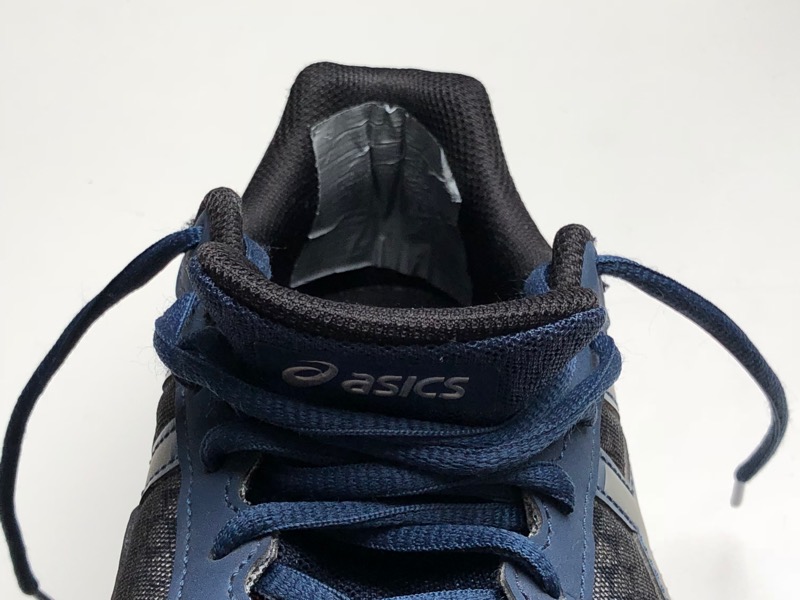
Even so, heel slip still appears to be a characteristic of my walking gait, and the heels started to wear through after I’d put in a mere just 150km on them. What I discovered, though, was that a strip of duct tape on the inside of the shoe works wonders.
Likewise, taping up my feet with plain Hansaplast sports tape works wonders for preventing blisters, and stopping them in their tracks when I feel a hot spot forming. I tend to tape up my heels, the balls of my feet, and the area just under my big toe. Discovering this was a revelation. I just need to pay enough attention to my body to actually stop and tape when I feel one starting rather than powering through to the next planned rest stop.
It takes my body about 5 days to re-absorb a foot blister if I don’t pierce and drain it. (So if I get a blister on a Sunday, walking again the following Saturday is not a problem.)
The shoes I have are size Asics Patriots, size 43.5. This size is just perfect for comfortable casual use, but on long walks my feet swell quite up quite a bit, to the point that these shoes are too small. Even though the material above the toes is flexible, the pressure and squeezing can sometimes cause some numbness in my big toe and index toe. I’m not sure if this means I should start off with a larger size shoe, or maybe bring a spare pair with me for switching part-way.
I walk much faster in cool weather than in warm weather. (9m40 to 10m15 per km kind of variability.)
No matter how much I pee before I leave the house, I always need to go again about an hour after I start.
There is a nice public toilet at Zaanse Schans that opens at 08:00, at least during the tourist season.
Finding the right balance between hydration and publicly available toilet spots is important.
Cubes of cheese, dried fruit, and Turkish delight make good snacks for on-the-go energy.
Long training walks are really boring. On my traditional long walks, I always walk to a destination. And I always stop off along the way to look at things and take pictures. But for the training walks I selected loops that started and ended at home, and I was walking them for speed, not for sightseeing. Even with a phone full of podcasts, the training walks felt like work, not pleasure.
I was using standard wired earbud headphones, and the cord inevitably got in the way, and got tangled whenever I put my pack on and took it off to grab a snack. When I bought a pair of noise-cancelling headphones last year, I was surprised by how their wirelessness quickly stood out as their defining feature for me. I don’t think they’d be good for long walks, though. They’re too tight around my head, and my ears get sweaty. A pair of Apple Airpods for occasions like this is tempting, but my long walks are longer than the 4-5 hour battery life they afford, and I worry that charging them up part-way through would be annoying. (Or worse: if the battery runs out just shortly before the end of a walk.) Also, Airpods aren’t any louder than standard earbuds, and quiet podcasts are already hard to hear if I’m walking alongside a busy road.
I’m close to wrapping up a project to tag all our old digital photographs with additional metadata that our cameras didn’t record at the time: mostly rotation orientation and GPS coordinates. This has involved a lot of internet detective work using Google Maps, Street View, and the various photos and panoramas that people have made publicly available for Google to index and publish. The detail with which I’ve been able to place our own photos on the map is amazing. It’s the kind of project that would have been impossible in 2000 when we bought our first digital camera (an Olympus C3000Z, ironically bought with the proceeds from selling the car we won from buying a pack of film).
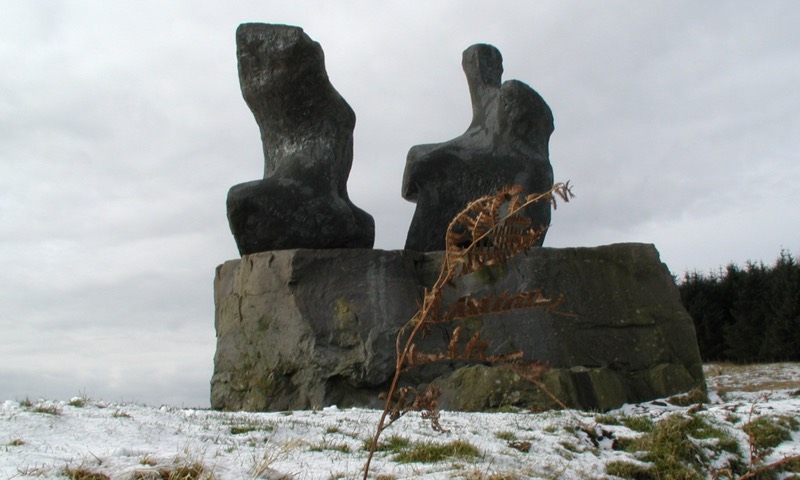
I’ve been working my way back in time, and I’ve reached 2001. In February of that year Abi and I took a trip to Dumfriesshire to have dinner at the Plumed Horse in Crossmichael. We stayed overnight at the Chipperkyle B&B, and the day after our meal we drove through the Glenkiln Sculpture Trail west of Dumfries. We stopped and took some photos near Henry Moore’s sculpture Two Piece Reclining Figure No.1.
Henry Moore Two Piece Reclining Figure No.1, photo taken on the Glenkiln Sculpture Trail in 2001
I had a vague recollection that we’d driven through a public sculpture trail on one of our trips to Dumfries, but without the internet and these modern search tools I would have been hard pressed to figure out exactly where it was, or what this particular sculpture was called. It would have taken a lot of library research.
Just like we have a bunch of photos of the old Hewit’s tannery on the Lanark Road in Edinburgh when it was still in action, the physical world doesn’t stand still. Things move, change, and disappear. Link rot isn’t just a digital thing: it applies to the physical world as well.