Dutch car license plates and traffic control

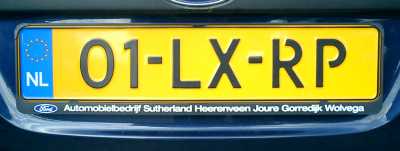
Dutch license plate: 01-LX-RP

The picture above shows a Dutch car license plate. Notice anything strange about it? Something odd about the letters “R” and “P”? The strokes of the letters are not completely joined up.

I’ve been trying to dig up some information about this typographic oddity, but I haven’t found anything concrete yet. My best guess is that styling these two letters this way makes computerised license plate identification easier. I’m no expert on optical character recognition, but it I’m sure that every little visual cue that distinguishes one character from another, helps in improving accuracy and processing speed. In the case of license plates, they must still remain easily readable by humans, so small adjustments, like the gaps in the letters “R” and “P” are probably a good compromise.

If you’re just taking a “wet film” image, or a digital snapshot of a car and its plates for later processing, then the speed and accuracy of identification of important, but not critical. If the computer system cataloguing the photos has trouble reading a given plate, it can flag an exception, and get a human being to check its work.

However, the Dutch police and Ministry of Transport are experimenting with traffic control systems where speed and accuracy of identification is critical. On the A-2 motorway between Amsterdam and Utrecht, they no longer just measure a car’s speed with a simple radar or laser speed camera. They use a connected network of cameras and detectors to identify cars at multiple places, so that the system is aware of the car’s average speed over that stretch of road.

It’s no longer any good just slowing down if you know a speed camera is up ahead, and then speeding up immediately afterwards. By measuring your average speed, you have to keep your speed down over that stretch of road.

Because you now need two cameras to monitor a stretch of road (one at the start, one at the end), you will be taking twice the number of images, and processing twice the number of license plates. If the accurancy of recognition remains the same as before, then you will also be generating twice as many exceptions, which requires twice as much human input to correct.

Also, because you have to correlate multiple data points, you have to identity the license plate correctly at both the entry and exit point in order to measure the car’s average speed.

Looking at this from the point of view of a motorist, say you have a 90% chance of being accurately identified at each speed camera. If you have to be identified by both cameras, then you have two chances of slipping through that 10% gap. The overall probability of getting caught therefore comes down to just 81%. (Note: 90% is just a number pulled out of thin air to make the point. The real-life identification rate will be different.)

Looking at it from the point of view of the system designers, if you want to maintain a 90% accuracy rate over the two cameras combined, then you have to increase the accuracy of each individual camera to about 95%. So accurancy becomes a hot issue.

Speed of processing also becomes much more important, because you now have to identify the license plate of every car that passes the camera, not just the ones radar tells you are breaking the speed limit. The number of license plates that need to be processed every takes an enormous leap upwards….

…which brings us back to the need for accuracy. Because the more identifications you make, the more error reports will be generated, and the more manpower will be needed to verify them. If the system is not accurate enough, it either becomes a manpower nightmare, or you end up with enough violaters slipping through the net that it’s no more effective than single-point speed cameras.

Does it work? Oh yes. Here are some statistics, from the Dutch Institute for Traffic Care (ITC):

  • 99.7% accuracy over the course of 24/7 operation
  • Number of speeding violations dropped by 90%, from 6% of traffic to 0.6%
  • Average speed on the monitored stretches of road has dropped from 72mph (115km/h) to 66mph (105km/h)

Accident rates have dropped, and congestion has decreased.

The gaps in the letters “R” and “P” on Dutch number plates are therefore just one element in a very interesting and highly advanced transport strategy.

Related Links

BT Midband: Just like ordinary dial-up, only without the good bits (part 3)

Well, after all the initial hassles of getting my parents hooked up to BT’s Midband/ISDN service (see parts 1 and 2 of this story), it’s finally working. And guess what? Once it’s up and running, it’s actually pretty good.

When I last left my parents, they had a freshly installed ISDN box with all the relevant sockets and wires…but no service. The main problems were that BT Midband doesn’t support Windows 2000 server through its USB interface, and that there was too much line noise on the ISDN line for a non-Win2K machine to connect at all.

Since that last time, they have had a BT engineer out who sorted out the line noise. On Wednesday I went up to visit them again, armed with an ISDN Terminal Adapter (TA). A TA is the only way you will get Midband to work with Windows 2000 Server. I bought a bog-standard BT Speedway PCI card. I could have got a non-branded card for less money, but after all of the earlier problems, I wanted something that would give me the least chance of being incompatibile.

The card was fairly easy to install in the server. The installation process tries to get you to install lots of voice, fax, voicemall, and data transfer widgets, but all I really needed were the device drivers to make it act like a modem. Once I had that going, I set up the dial-up networking connection, crossed my fingers, and….

…it worked! First time! Yay!

Continue reading “BT Midband: Just like ordinary dial-up, only without the good bits (part 3)”

Space Elevator

Via (ultimately) Electrolite, I just came across a wonderful blog dedicated to the Space Elevator. If you’ve never come across the space elevator idea before, it’s basically a giant cable that stretches vertically from the equator right up into space. Strap some powered cargo or passenger capsules to the cable, and you’ve got an express lift to geostationary orbit–and beyond.

The surprising thing about the space elevator is how damn feasible it is. It sounds insane at first, but the physics behind it is simple. And although building the cable would be expensive, once it is in place, it is vastly cheaper at lifting stuff into orbit than conventional rockets.

Yes, there are technical issues to overcome before we could actually build one in real life, but they are mostly in the realms of materials science and engineering. Primarily, it’s a question of creating a material that is strong, light, and cheap enough to make the cable. But there are no fundamental theoretical hurdles to overcome.

The blog features a great paper by Arthur C. Clarke that explains the theory of the space elevator, some of its practical issues, and the history of the idea: “The Space Elevator: ‘Thought Experiment’, or Key to the Universe?” (Note that this is a paper from 1981. The space elevator idea has been around for a long time.) Two novels that give an excellent treatment of the concept are Clarke’s The Fountains Of Paradise and Kim Stanley Robinson’s Red Mars.

A reviews blog (or sidebar reviews) with Movable Type

I often get depressed about the fact that, on average, I read less than a book a week. That’s less than 52 books a year! Compared to the thousands of new books published each year, and hundreds of thousands more already in or out of print, 52 seems like a vanishingly small number. I feel like I have to make those 52 count.

Around this time last year I decided to do a “reading list” in my sidebar. Originally, it was just going to be a simple way for me to keep track of the books I’d read. I’d be able to browse through the list at the end of the year, and maybe compile a list of favourites. Friends and family who read my blog could also see the list and find out what was catching my fancy. I’d seen various other bloggers with reading lists in their sidebars. With Movable Type as my blogging back-end, it would be fairly straightforward to set up “reading list” sidebar in the same way as some people do sidebar links.

But then I realised that I could do more with the format…. I could track films I’d seen as well. With a little more effort I could write a short paragraph about the book or film to remind me what I thought about it at the time. How about giving them ratings as well? And by hooking in to Amazon I could add images to the mini-reviews so that people could see a book’s cover, and hop over to Amazon to see what other people thought of it.

And so the “Quick Reviews” sidebar was born.

The rest of this article will explain how to use Movable Type to set up a “Quick Reviews” blog or sidebar of your own. This certainly isn’t the only way to do it, but it’s relatively simple and tidy. There are no extra CGI scripts to install, no new database tables to create in your MT installation, and no kooky javascript or PHP files to scatter around your templates.

Please don’t be put off by the length of the article. It’s long because the technique takes some time to explain. But if you’ve installed Movable Type, then you’re capable of setting up a reviews blog. I’ve also tried to explain why each step works the way it does, so that you’ll be better placed to do your own customizations afterwards.

Continue reading “A reviews blog (or sidebar reviews) with Movable Type”

Hotmail spam

Is it just me, or has Hotmail suddenly got much better about trapping spam? I used to get about 6 or 7 spam messages a day in my Hotmail inbox, but in the last three weeks there has been nothing at all.

The volume of junk mail hasn’t decreased. I’m still getting the same number of messages, but now every one of them is getting routed straight into my “Junk” folder, and is automatically deleted after a week. I haven’t noticed any real email disappearing into the void, either.

New Barenaked Ladies Album

According to the Barenaked Ladies mailing list, the band have a new album, Everything to Everyone coming out on October 21st. I was reading the BNL’s blog while they were recording the album, and it’ll be interesting to see some of the things they were talking about there in their finished form. It’s a shame they haven’t kept on using the blog since then.

No tour information yet. But if they hit Scotland again, sign me up for a bunch o’ tickets. They were fantastic last time!