Unemotional Design: the new Scottish Parliament building at Holyrood

After seeing some photos of it on Alister Black’s blog, I felt inspired to visit the new Scottish Parliamant building at Holyrood, and the four of us trundled down there yesterday morning. It’s a truly extraordinary building. The architecture is lavishly unconventional, and almost every lower-level design feature, from the window frames to the chairs in the public gallery of the debating chamber, look like they could have been plucked straight from an modern art gallery. There isn’t a building like it in the whole of Scotland.

But.

Extraordinary doesn’t necessarily mean good, or appropriate, or worth what we spent on it (about £500 million–some ten times its initial budget).

In his book Emotional Design: Why we love (or hate) everyday things, Don Norman talks about three levels of design: visceral, behavioural, and reflective. Visceral design is all about plugging straight into the emotional centres of our brains. It’s about making things look, sound, and feel so good that their first impression has emotional and instinctive impact. From Emotional Design:

Because visceral design is about initial reactions, it can be studied quite simply by putting people in front of a design and waiting for reactions. In the best of circumstances, the visceral reaction to appearance works so well that people take one look and say, “I want it.” Then they might ask, “What does it do?” And last, “And how much does it cost?” This is the reaction the visceral designer strives for, and it can work.

Behavioural design is about using design to guide people’s behaviour, both consciously and subconsciously. It’s about functionality: making sure that people can use a thing to carry out the tasks it is intended to do. It’s where usability comes into play.

Finally, reflective design is about message, meaning, and perception. It’s the aspect of design that appeals to the intellect rather than the emotions. This can be tied to cultural factors, for example, knowing when a particular outfit will be right for a particular occasion. Or it can be tied to cleverness, for example, by subtly obscuring the purpose of a thing until an “oh!” moment of insight kicks in. Don Norman again:

Whether we wish to admit to it or not, all of us worry about the image we present to others–or, for that matter, about the self-image that we present to ourselves. Do you sometimes avoid a purchase “because it wouldn’t be right” or buy something in order to support a cause you prefer? These are reflective decisions. In fact, even people who claim a complete lack of interest in how they are perceived–dressing in whatever is easiest or most comfortable, refraining from purchasing new items until the ones they are using completely stop working–make statements about themselves and the things they care about. These are all properties of reflective processing.

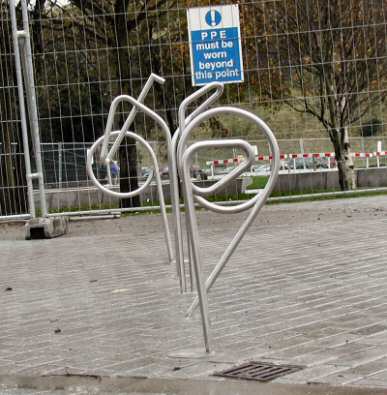
The biggest mistake the Holyrood Building makes, in my opinion, is that its designed is wholly reflective. When I look at it, I find it beautiful because it is intricate, precise, modern, different, and amazingly clever. Take, for example, the design of the bicycle stands outside the main entrance:
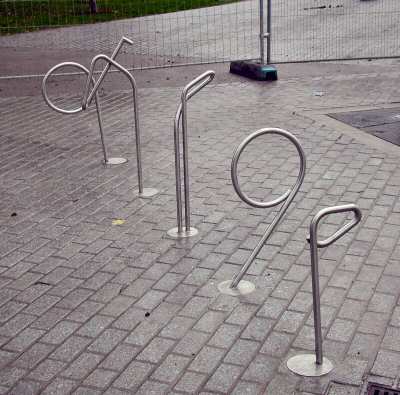
Scottish Parliament bike rack - side view
Scottish Parliament bike rack - front view

From the side, they just look like oddly twisted tubes of steel that you could chain a bike to. It’s only when you line them up and view them from the right height that they themselves resolve into the shape of a bike. Clever!

What I don’t feel when looking at it is, well, anything, really. It’s a purely intellectual appreciation. I don’t feel any kind of national pride stirring in my breast when I see it. There is no sense of majesty, or awe. No feeling that I’m looking at at an edifice with historical stature or permanence. There is no visceral component to it. I don’t think I’ll ever love it.

I think this is partly because of the location of the building: tucked away right down at the foot of the High Street, squeezed in behind a phalanx of offices and apartments. You don’t get anything more than a tantalising glimpse of it until you’re right there. Because all the land around it is built up, you can’t walk back a hundred yards to get a better view. (Or rather, you can, but you have to climb half-way up the Salisbury Crags, the hill that rises to the South in Holyrood Park. There’s no good view at ground level.)

Also, the building has no single front to it. Because it is so architecturally intricate and clever, it presents an interesting and totally unique face to each of a dozen different viewing angles. It has no identifiable silhouette. It has no single feature with souvenir potential. In a way, it feels like a hypercube: a shape that mere 3-dimensional beings are fundamentally unequipped to perceive as a whole.

This is a particular problem in Edinburgh, which is, in visual terms, dominated by the castle at its heart. I know that the parliament building was never intended to rival the castle for grandeur–especially as it’s Scotland’s parliament, not just Edinburgh’s. Still, leaving aside questions of what the money would have been better spent on, I feel that for half a billion pounds we ought to have got something magnificent in return.

High

Just a quick plug for the new album by Scottish band The Blue Nile: High. Mellow, melodic, deliciously moody, and over far too quickly. I’ve only listened to it a few times, but I can tell it’s going to stay under my skin for a long time. You need to own this disc.

Update (5 November): After listening to it a few more times, it seems to have lost some of its initial magic. There are still about three or four stand-out tracks on it, but the overall brilliance seems to have worn off rather quickly. Huh. So much for my musical radar.

The coming of winter

The clocks changed at the weekend. The days have been getting noticeably shorter for some time, and it is full dark now when I leave work in the evenings. Edinburgh is at latitude 55°N (ish), which puts us about 1200km (760 miles) away from the Arctic circle. That might sound like a lot, but it means we only get about seven hours of daylight at midwinter.

Trying to look on the bright side of this, going to work in in the mornings, with the sun rising after 8 o’clock, can be extraordinarily beautiful. We live on the South side of the city, which, on a clear morning, gives us a lovely view of dawn breaking over the Pentland Hills. And it’s a curious but fortuitous feature of Edinburgh’s micro-climate that even when the day turns out dreich, the mornings often start off crisp and clear.

In November of last year I was cycling to work in Dalkeith just a few miles away, and I regularly found myself stopping by the side of the road to watch the raking light spread over frosty fields. There was a particular spot that I loved, on the bridge over the river Jewel, where ghostly whirls of mist drifted lazily over the water’s surface. Craggy trees lined the banks, their trunks still in the shade, but their branches glowing like molten gold. With cars whizzing by right next to me, looking down on this was like staring into a magical other world.

I treasured that beauty throughout each day. It was my Happy Place when things got bad.

With George Bush in the White House for a second term of office, we will surely see a winter of a different sort descend on the US. For us foreigners it is easy to question and curse the stupidity of a country capable of electing such a leader. But it is also easy to forget that approximately half the population of the US is just as–if not more–strongly opposed to his policies and hegemonic rule as the rest of the civilized world.

We must not forget that the US is a nation of many different states, and hundreds of millions of individuals. The Republican Party may be its current political figurehead, but when we visit the place called “America”, we don’t visit the country as a whole: we visit California, or Massachusetts, or New York. When we talk to “Americans” in everyday life, we’re not talking to members of a brainwashed clone army: we’re talking to friends, family, Bob at the office, or Carol behind the counter at Starbucks. Individuals with hugely diverse opinions and desires, even though they may belong to the same political party.

If you need a Happy Place to see you through the darker days of the next four years, think of an American individual you like, love, admire, or respect. Then think of five more. Then a dozen, or a hundred. Then realize: these people are not just Americans, they are America.

I’m not suggesting that Bush’s opponents and critics, both at home and abroad, should just shrug, and try to make the best of a bad result. Not at all. But the opposite reaction–turning away in disgust from the apparent futility of political engagement, or losing faith in the cognitive abilities of the American electorate–is a much more certain road to further defeats two, four, ten years further down the line. To carry on the fight, you have to remember what you’re fighting for.


On an even more positive note, here are three reasons why a Bush victory might well be a good thing:

  • The Bush presidency has had a unifying effect on Europe: he’s a hate-figure to rally around. With ten new countries in the Union, and the new European Constitution just agreed, but not yet ratified, we’re going to need all the unity we can get in the next few years.
  • Here in Britain, Tony Blair is going to take a political knock from his closeness to the Bush administration, and from his failure to endorse Kerry. With a general election expected some time next year, it would be pretty sweet if this would pull enough of the rug from under the Labour party to force a coalition government.
  • The US dollar is going to head even further down the toilet. For us Europeans planning holidays in America, exchange rates are going to rock!

iPod Photo

The new iPods go up to 60GB, have better battery life (up to 15 hours), and have a colour screen for showing off your photo collection. They plug into TVs, too, which is highly nifty, and possibly more of a killer feature than it sounds at first.

Still no radio, though.

100 Films

About half-way through this year I admitted to myself that I wasn’t going to make my target of reading 50 books in 2004. My commute time has traditionally been when I’ve read the most, and now that I’m driving to work, I’m barely getting through a book a month.

So I set myself a different goal: I would watch (and write quick reviews of 100 new films, instead. (New to me–not necessarily brand new releases.)

I slacked off a bit on the viewing in July and August, but I’ve been picking up the pace lately. I hit 60 films in mid-September, and I’m up to 78 now, although I haven’t posted reviews of all of them yet. (I’ve got a backlog of 8 to work through.) That leaves me with another 22 films to see, and only 10 weeks left to go in 2004. (If you’re terribly interested in my score, you can keep track over here.)

Two-and-a-bit films week should be achievable, but I’m getting a bit worried by the number of games being released in the run-up to Christmas. We’ve got Halo 2, Half-Life 2, Ratchet and Clank 3, and Jak 3 all being released in the next month, and I just noticed yesterday that Metroid Prime 2: Echoes is going to be out in November, too.

This has the potential to seriously mess with my plans.