Health warning: graphic (yet humorous) descriptions of sick toddler to follow. Turn away now if you’re squeamish.
The usual way for us to tell if Alex is ill is whether he is throwing up all over the house. He barfs at the slightest provocation. Mild fever? Puke. Something caught in his throat? Hurl.
So his behaviour last weekend was odd to say the least. On Saturday evening we were sitting around the living room just before his bathtime, when Alex said he was going to be sick. We snapped to attention and had a kitchen bowl by his side in seconds. Nothing came of it, though. He went to bed with the bowl by the side of his bed, and he was fine all through the night.
The following morning, he was feeling a little warm. Not a raging fever by any means, but definitely an elevated temperature. Certainly nothing that would deter us from our usual weekend cinema trip, so we bundled out of the house to see Cheaper By The Dozen. We bought our usual drink, packet of sweeties, and bag of popcorn to share. But although Alex had expressed great interest in buying them, he didn’t eat more than a couple of sweets, and only had a sip or two to drink. Then, as we were most of the way through the film, he turned to me, and in a small voice said, “I have to be sick.”
A rapid exit followed. By the time we got to the toilet, though, he said he was feeling fine again, and only wanted to pee before returning to catch the end of the film.
The rest of Sunday progressed fairly normally. He stayed mildly fevered, and his appetite never returned, but he remained in excellent spirits. We met up with my parents and some friends of theirs from the Netherlands (hi Paul & Mini!), and hung out at the Scottish National Gallery of Modern Art, and the Dean Gallery. (Both of which rock to an enormous extent, by the way. Beautiful settings, relaxing and pretty places to just hang out, and spectacular collections of important art. Good cafés. We’re adding these to the list of places that we must take visitors when they come to stay with us.) Alex was very tired when we got to the end of the day, though.
On Monday, he was not terribly happy when I got him up from bed. He was still feeling warm, and he was more than normally grumpy. It was Fiona’s first day at Nursery, so his weekday morning routine was out of order already, and I put much of his bad humour down to that fact. But when we got to Goose, he lost the plot completely. He screamed and cried like he hasn’t done since his first months there. He was alternately hitting me and clinging to my legs with a desperate grip. He point-blank refused to let me take his jacket off, and in the end Susan (one of the Gooses) offered to take him away and settle him down. He was totally freaked. I was freaked.
Apparently, once he had settled down, he had a fine time for the rest of the day. He was still warm when he got home. When I took him up for an early bath and bedtime (he was very tired), I noticed a bunch of small pink splotchy spots on his upper chest, back, and neck. We considered the possibility of chickenpox (waterpokken for the Dutch audience) at that time, but it’s not the first time Alex has had a slight splotchy rash accompanied by a mild fever. So we reckoned that we’d wait until the next morning and see how he was then.
On Tuesday morning I pulled his pyjama shirt off to find even more spots. Chickenpox was emerging as the forerunner in the diagnosis race:
Symptoms begin with a low grade fever, loss of appetite and decreased activity. About two days later, your child will develop an itchy rash consisting of small red bumps that start on the scalp, face and trunk and then spread to the arms and legs (but may also occur in the mouth and genitalia). The bumps then become blisters with clear and then cloudy fluid, and then become open sores and finally crust over within about twenty four hours, but your child will continue to get new bumps for about four more days.
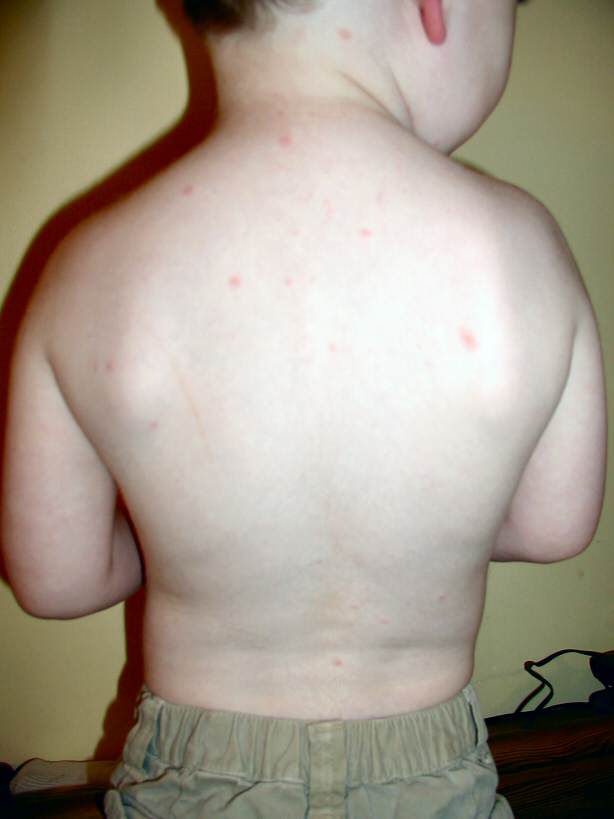 Low grade fever, check; loss of appetite, check; small red bumps that start on the scalp, face and trunk, check. But still, I wondered. He didn’t seem to be in any great discomfort. In fact, he seemed energetic and active. Was it really chickenpox? Monday had been a warm day, and Alex had been playing in the garden at nursery. Could the spots have been a heat rash, an allergic reaction, or insect bites? Alex wasn’t scratching himself much, so maybe the bumps weren’t itchy. What did that mean? Also, various web sites I checked suggested that around 300 spots was “normal” for a case of chickenpox. I counted about 35-40 all over Alex’s face, neck, and torso. Was that enough to really make it chickenpox?
I decided to call the nursery to ask them for advice. After all, they regularly see cases of chickenpox, so they should know. I outlined Alex’s symptoms to them, and I could pretty much hear Kirsty nodding at the other end of the line. Yup, she said, it was chickenpox. Apparently there were seven kids off sick with chickenpox about three weeks ago, and there were another three kids who had it this week. The evidence seemed pretty conclusive.
Alex, therefore, has been at home since Tuesday. I stayed home with him on Tuesday and Wednesday, and Abi was here on Thursday and Friday. The nursery was quite happy for Fiona to stay in care during that time. Chickenpox has an incubation period of 2-3 weeks, which means that Alex must have picked it up 2-3 weeks ago, well before Fiona was at nursery. However, this also means that Fiona has been exposed to the virus, and may well erupt in spots a fortnight from now. We’ll just have to wait and see.
The disease seems to have run its course now. From 35-40 spots on Tuesday morning, Alex was up to about 65 by the evening. Wednesday morning I counted around 80, and on Thursday morning Abi found 100. Most of these, however, remained as small pinkish splotches and are fading away again rather than developing into the characteristic tiny blisters, and today he was back down to about 70-80 again. Alex is being a really good boy and not scratching himself too much, and he is even being very brave about the two rather sore-looking blisters on his gums. Basically, it just doesn’t seem to have been a very severe case. 100 spots might sound like a lot, but when you spread them out over a body’s entire surface area, there’s still an awful lot of clear skin visible.
Poor Alex. But what a good little boy.